Speed Vegan - Recipes


HERE ARE A FEW RECIPES FROM SPEED VEGAN FOR YOU TO TRY.

You’ll find all of these recipes in the book.


Hot Eggplant and Seitan Open-Face Sandwiches

Makes 4 servings
I was imagining possible ways to use seitan when this combination came to me. Even my eighty-four-year-old mother enjoyed it. If you have any fresh shiitake mushrooms, they would go well too; slice them and add them to the sauce.

1 medium-size eggplant
3 tablespoons almond or extra-virgin olive oil
2 teaspoons toasted sesame oil
1⁄4 teaspoon sea salt
1 cup tomato purée
1⁄4 cup hoisin sauce
1 tablespoon dark agave nectar
8 ounces seitan, cut into 1⁄2-inch-thick slices
4 large slices sourdough bread or your favorite French bread                                                                                       
8 scallions, thinly sliced
1 tablespoon sesame seeds

Preheat the oven to 450 degrees F. Put a baking pan on the middle rack.
Heat a stovetop grill over high heat.
Prepare the eggplant while the oven and grill are heating. Cut a lengthwise strip off both sides of the eggplant to expose the flesh. Cut the eggplant into 4 thick slices parallel to the cut sides. Combine the almond oil with 1 teaspoon of the sesame oil in a small bowl. Brush the eggplant slices very lightly on both sides with about half of the oil mixture. Arrange them in a single layer on a plate or tray. Sprinkle both sides of the eggplant slices with the salt.
Put the eggplant on the hot grill and cook for about 5 minutes on each side. Transfer the eggplant to the baking pan in the oven. Keep the grill hot.
To make the sauce, combine the tomato purée, hoisin sauce, agave nectar, and remaining teaspoon of sesame oil in a small saucepan over medium heat.
Toss the seitan slices with the remaining oil mixture. Put them on the grill and cook for about 3 minutes on each side. Add the seitan to the sauce and stir well. Decrease the heat to keep the sauce and seitan hot but not bubbling.
Toast the bread slices and put one slice on each plate. Put an eggplant slice on each piece of toast. Divide the hot seitan and sauce among the 4 slices, covering the eggplant. Sprinkle with the scallions and sesame seeds. Serve at once.


Pimiento Soup with Vermouth

Makes about 4 servings

The slightly bitter character of vermouth adds a layer of flavor complexity that enhances the pimientos dramatically. With a mere tablespoon of olive oil, this is an amazingly rich soup, reminiscent of classic tomato bisque but without the hassle. Very sexy. I recommend serving it in small teacups as a starter for an elegant dinner. If you don’t like to use alcohol in your food, simply omit this ingredient and call it “Pimiento Soup,” which will be an unusual, very tasty dish all the same.
1 tablespoon extra-virgin olive oil
1 yellow or white onion, finely diced
9 cloves peeled garlic, finely chopped
11⁄2 cups (three 4-ounce jars) pimientos, rinsed,
drained, and coarsely chopped
2 vegetable bouillon cubes
1 teaspoon smoked paprika
4 cups water
1⁄2 teaspoon sea salt
1 small russet potato
1⁄4 cup dry vermouth, preferably Noilly Prat (optional)                                                                                                               
1⁄4 teaspoon freshly ground black pepper
1 teaspoon snipped fresh chives

Put the oil in a large soup pot over high heat. Add the onion and cook and stir for 1 minute. Add the garlic and cook and stir for about 1 minute. Add the pimientos, bouillon cubes, and paprika and cook and stir for 1 minute. Add the water and salt and bring to a boil.
Peel the potato, and then grate it directly into the pot. Stir well. Decrease the heat to medium-high and simmer for 10 to 15 minutes, or until the vegetables are very tender. The liquid should be reduced to about 11⁄2 cups.
Transfer the mixture to a blender and process until very smooth. (Be careful, as the hot mixture may want to blast out of the blender. Pulse a few times before turning the blender on fully.)
Return to the pot and reheat. When the soup is hot, add the vermouth and pepper and stir well. The consistency should be very creamy, but if the soup is too thick, add just a little water. Serve in small cups, with a sprinkling of the chives on top.


Leek and Cauliflower Soup

Makes about 6 servings

Cauliflower and curry flavors go well together, which in this case is hinted at by the addition of ras el hanout, a Moroccan spice mixture slightly reminiscent of Indian curry but uniquely North African in character. Feel free to substitute an Indian curry powder for the ras el hanout in this recipe—it will be delicious either way.
1 head cauliflower
3 tablespoons extra-virgin olive oil
4 leeks (white and green parts), finely diced
1 potato, peeled and finely diced
7 cloves peeled garlic, chopped
1 tablespoon ras el hanout or Indian curry powder                                                                                                          
1 teaspoon sea salt
1 quart water
3 vegetables bouillon cubes
1 cup fresh or frozen peas
1⁄4 cup chopped fresh cilantro

Break the cauliflower into small florets, reserving the very smallest ones separately from the rest (about 1 cup).
Heat the oil in a large soup pot. Add the leeks, potato, and cauliflower (except for the reserved cup of very small florets). Cook and stir for 1 or 2 minutes, until the vegetables begin to release their juices. Add the garlic, ras el hanout, and salt. Decrease the heat and cook and stir until the mixture is almost dry, about 3 minutes. Add the water and bouillon cubes. Increase the heat to high and bring to a boil. Decrease the heat and simmer for about 15 minutes, or until the vegetables are tender.
While the soup is cooking, bring a small pot of water to a boil over high heat. Add the peas and the reserved cup of cauliflower florets. Decrease the heat slightly and cook until just tender, about 5 minutes. Drain and reserve.
When the leeks, potato, and cauliflower are tender, remove from the heat. Working in small batches, process the vegetables and their cooking liquid in a blender. Return the blended mixture to the pot. Stir in the reserved cauliflower and peas.
Warm the soup over medium-low heat. Taste and add more salt, if needed. Stir in the cilantro. Serve at once.


Beet and Celery Root Salad


Makes 4 to 6 servings

This visually stunning salad is a meal that will fill you up but won’t weigh you down. If you have trouble locating both arugula and watercress, simply use a double quantity of whichever one you find. I like to cut the vegetables into very fine julienne (thin as matchsticks), but if this seems too taxing, just grate them. If you can’t find celery root, substitute with celery stalks, peeled and cut the same way.

1 bunch arugula
1 bunch watercress
1 large beet
1 small celery root
1 tart apple
1 small red onion
1⁄3 cup freshly squeezed lemon juice
2 tablespoons Roasted Garlic Purée
(see video clip)
1 tablespoon Dijon mustard
1 tablespoon agave nectar
1⁄2 teaspoon sea salt
1⁄4 teaspoon freshly ground black pepper                                                                                                                         
1⁄4 cup extra-virgin olive oil
1⁄4 cup flax oil
1⁄2 cup broken walnuts
Remove any coarse stems from the arugula and wash in plenty of water along with the watercress leaves. Allow the greens to soak and crisp while you prepare the rest of the salad.
Peel the beet, celery root, and apple. Cut them into fine julienne or coarsely grate them. Cut the onion in half lengthwise, and then thinly slice it crosswise.
Combine the lemon juice, Roasted Garlic Purée, mustard, agave nectar, salt, and pepper in a large bowl. Whisk until well blended. Whisk in the olive and flax oils and continue whisking until emulsified. Add the julienned vegetables and toss until well coated. Let sit for about 5 minutes.
Drain the arugula and watercress. Dry it in a salad spinner or roll it gently in a towel to absorb the excess water. Add to the vegetables and toss well. Divide among 4 to 6 plates. Sprinkle the walnuts on top. Serve at once.


Green Curry Salad

Makes 4 servings

With its bright tastes and crunchy textures, this salad is a crowd-pleaser. Just beware: it has to be eaten right away, so whatever you do, don’t add the dressing until just before you’re ready to serve it. If watercress isn’t available, substitute with Chinese cabbage, mustard greens, Tuscan kale, tat soi, mizuna, baby bok choy, or any combination of these.
11⁄2 cups thinly sliced green or savoy cabbage                   
1 bunch watercress
8 ounces mung bean sprouts
3 stalks celery, thinly sliced on a diagonal
1 carrot, grated
1 lime
1⁄2 cup packed fresh basil leaves
5 tablespoons brown rice vinegar
4 tablespoons flax oil
4 cloves peeled garlic
1 tablespoon Thai green curry paste
1 teaspoon sea salt
1⁄2 cup toasted cashews, lightly crushed                                                                                                                            

the cabbage, watercress, bean sprouts, celery, and carrot in a large bowl.
Carefully peel the zest from the lime with a vegetable peeler as thinly as possible and put it in a blender. Squeeze the lime juice into the blender. Add the basil, vinegar, oil, garlic, curry paste, and salt. Process for about 1 minute, or until smooth. Pour over the vegetables in the bowl. Toss thoroughly. Divide among 4 plates. Top with the cashews. Serve at once.


Campari-Braised Radicchio Salad with Grapefruit

Makes 4 servings

Campari, an Italian bitter aperitif made from herbs, enhances the bitterness of radicchio while paradoxically softening its edge. This salad must be assembled immediately before serving, as the heat from the braised radicchio will warm the grapefruit and cause the watercress to wilt fairly quickly. When properly done, however, the result is near transcendental.

2 heads radicchio
1 red onion
1⁄2 teaspoon freshly ground black pepper
1 bunch watercress
2 grapefruits
2 teaspoons agave nectar
2 teaspoons freshly squeezed lemon juice                                                                                                                        
1 teaspoon Dijon mustard
1 teaspoon sea salt
5 tablespoons extra-virgin olive oil
1⁄4 cup Campari

Quarter the radicchio lengthwise, but leave the core to help keep the leaves together. Cut each quarter crosswise into slices a little thinner than 1⁄2 inch thick. Discard the core pieces. Quarter and slice the onion the same way, but make the slices about 1⁄8 inch thick. Combine the radicchio and onion in a bowl. Season with the pepper and set aside.
Wash the watercress, and then crisp it in cold water for 5 to 10 minutes. Dry it in a salad spinner or roll it gently in a towel to absorb the excess water. Refrigerate until serving time.
Cut the tops and bottoms off the grapefruits. Put the grapefruits on a flat work surface and cut off the remaining peel by slicing downward, following the curve of the fruit. Cut between the membranes to loosen the segments. Transfer the segments to a bowl and set aside. Squeeze the remaining pieces to extract the juice, discarding any seeds. You should have about 1⁄2 cup of juice.
Pour 3 tablespoons of the grapefruit juice into a small bowl. Add the agave nectar, lemon juice, mustard, and 1⁄2 teaspoon of the salt. Whisk until well blended. Slowly add 3 tablespoons of the oil, whisking until emulsified.
Swirl the remaining 2 tablespoons of oil in a large skillet or wok over high heat. Add the radicchio and onion, stirring well until they begin to wilt. Add 1⁄4 cup of the remaining grapefruit juice, the Campari, and the remaining 1⁄2 teaspoon of salt, stirring well. Continue to cook over high heat until the liquid is absorbed and the radicchio has thoroughly wilted, no more than 2 minutes. It should be tender-crisp. Remove from the heat.
Place the reserved watercress and grapefruit sections in a large bowl. Add the radicchio mixture and the dressing all at once, tossing gently but thoroughly. Divide among 4 plates, mounding it slightly. Serve at once.


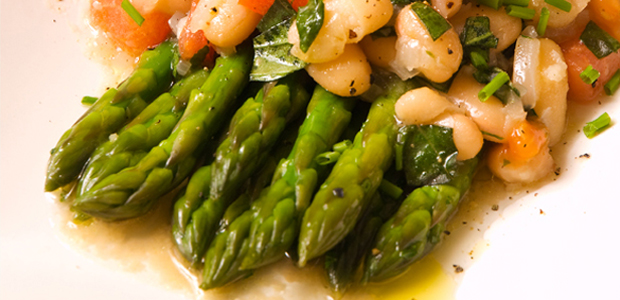
Asparagus with Cannellini

Makes 4 servings

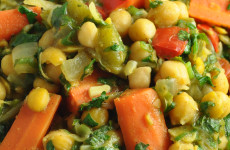
This is one of those Mediterranean-style dishes that are perfect served hot, at room temperature, or cold—wonderfully versatile for entertaining. Throwing the tomato and basil in at the end, off the heat, is the secret to the success of this feat of flavor and texture. If at all possible, use freshly picked, vine-ripened tomatoes and very fresh, verdant basil; even the most pedestrian can of cannellini beans will magically come to life under the touch of these two ingredients alone.
1 tablespoon plus 1⁄4 teaspoons sea salt
2 tablespoons extra-virgin olive oil
1 cup finely diced red onion
2 cloves peeled garlic
1 can (15 ounces) cannellini beans, with liquid
1⁄2 teaspoon red wine vinegar
1⁄4 teaspoon freshly ground black pepper
1 pound asparagus spears, trimmed uniformly to                      
about 6 inches in length
1 medium-size ripe tomato, cut into 1⁄2-inch dice
1⁄4 cup coarsely chopped fresh basil
2 tablespoons flax oil
1 tablespoon snipped fresh chives (optional)                                                                                                                    

Fill a large pot of water. Add 1 tablespoon of the salt. Cover and bring to a boil over high heat.
Meanwhile, put the olive oil in a large pan over medium-low heat. Add the onion, stirring well. After 1 to 2 minutes, when the onion juices begin to flow, squeeze the garlic through a garlic press directly into the pan. Add the cannellini beans and their liquid along with the vinegar, pepper, and remaining 1⁄4 teaspoon of salt. Stir thoroughly but gently, to avoid crushing any of the beans. Bring to a simmer, and then decrease the heat to very low and cover. Continue to cook, stirring often, while you prepare the asparagus.
When the pot of water comes to a rolling boil, drop in the whole asparagus spears and stir once. Depending on the thickness of the asparagus, they should be just tender-crisp in about 1 minute. When they are done to your satisfaction, drain well.
Remove the beans from the heat and stir in the tomato, basil, and flax oil.
Divide the asparagus among 4 plates. Top with the bean mixture. Garnish with the chives, if using. Serve at once.


Strozzapreti with Mushrooms

Makes 4 servings

You gotta love Italians—the name of this oddly twisted shape of pasta, strozzapreti, means “priest stranglers.” One wonders what sort of passive-aggressive activity is implicit there. For this dish, I chose whole-grain strozzapreti made from farro, a delicious relative of wheat grown in Northern Italy. Any mushrooms you can find fresh will be good for this, although wild mushrooms have spectacularly rich flavors.
1⁄2 pound of strozzapreti di farro or your favorite pasta                                                                                                   
1⁄4 cup plus 1 tablespoon extra-virgin olive oil
1 tablespoon plus 1⁄2 teaspoon sea salt
1⁄2 cup chopped shallots
2 pounds mixed mushrooms (see tip)
1⁄2 cup dry Marsala, dry sherry, or tawny port
1 vegetable bouillon cube
1 tablespoon porcini mushroom powder (optional)
1⁄2 teaspoon freshly ground black pepper
1⁄4 cup flax oil
2 tablespoons freshly squeezed lemon juice
2 tablespoons chopped fresh parsley

Fill a large pot with water. Add 1 tablespoon of the oil and 1 tablespoon of the salt and bring to a boil. Add the pasta, stirring well to prevent sticking. Cook for about 12 minutes, or until done to your liking. (This will vary according to the shape of the pasta as well as its composition.)
While the pasta is cooking, quickly proceed with making the sauce. Heat the remaining 1⁄4 cup of olive oil in a large pot. Add the shallots and cook and stir for about 2 minutes, until softened and lightly colored. Add the mushrooms and stir well. Cover the pot until the mushrooms release their liquid, about 1 minute.     Remove the cover and add the bouillon cube, mushroom powder, remaining 1⁄2 teaspoon of salt, and pepper. Stir well. Cook for 5 minutes, or until the liquid is absorbed and the mushrooms begin to brown a bit. Add the Marsala, stirring to incorporate any browned bits into the sauce.
As soon as the pasta is done, drain it in a colander (without shaking!). Quickly add the pasta to the pot of mushrooms. Shake the pot back and forth to toss the pasta into the sauce. Remove from the heat and add the flax oil, lemon juice, and parsley, shaking the pot back and forth to mix well. Serve at once.


Chocolate Pots de Crème
Makes 4 servings

Where there’s a will, there’s a way. I never would have imagined that I could get the creamy texture of a classic pot de crème without the cream and egg yolks, but here (voilà!) it is. You’re welcome. The basil and pepper add an ethereal flavor to this dish that most people won’t be able to put their finger on but will still know is there. I like the idea of delighting their palate and messing with their heads with the same gesture. It’s fun.
1 can (14 ounces) coconut milk
5 ounces bittersweet chocolate,
coarsely chopped
1⁄2 cup fresh basil leaves, coarsely torn
2 tablespoons agave nectar
1 teaspoon finely grated orange zest
1⁄2 teaspoon vanilla extract, preferably Tahitian                                                                                                               
1⁄4 teaspoon crushed Javanese comet’s tail
peppercorns or black peppercorns

Put the coconut milk in a small pot over medium-high heat and bring to a simmer.
Put the chocolate in a blender and pour the hot coconut milk over it. Add the basil, agave nectar, orange zest, vanilla extract, and peppercorns. Process on high until the chocolate is thoroughly melted and the mixture is smooth. Strain through a fine-mesh sieve.
Divide among 4 small cups. Cover and refrigerate until set, about 3 hours.


Mangoes and Lychees with Mint

Makes 4 servings

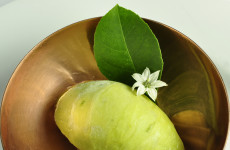
I first devised this dish as an accompaniment to a coconut Bavarian cream I was serving after an Asian meal—later realizing it was sublime on its own, as a kind of exotic fruit compote.
2 ripe mangoes
1 can lychees (see tip)
2 tablespoons brown sugar
2 tablespoons freshly squeezed lime juice                                                                                                                        
1 tablespoon grated fresh ginger
24 fresh mint leaves

Peel the mangoes, and then cut them into cubes about 3⁄4 inch thick and put them in a bowl. Squeeze the juice from any pulp remaining on the pit into a separate small bowl and set aside.
Drain the lychees, reserving 1 tablespoon of the syrup.
Put the brown sugar and the tablespoon of lychee syrup in a heavy saucepan over high heat. Cook and stir for 2 to 3 minutes, until the sugar dissolves and the mixture caramelizes. Add the mangoes and stir gently a few seconds. Then add the lychees, lime juice, the reserved mango pulp and juice, and ginger. Shake the pan as the mixture bubbles for about 1 minute. Remove from the heat and let cool slightly.
Gather the mint leaves into 2 or 3 stacks. Slice them crosswise into 1⁄8-inch shreds. Fluff slightly to separate them.
Divide the mango mixture among 4 bowls. Scatter one-quarter of the mint leaves on top of each serving. Serve at once.